
.avif)
.avif)

The best presentation software no longer just displays slides — it designs them for you, keeps your team on brand, and exports clean files wherever your audience needs them. Whether you need a full-featured PowerPoint alternative or a specialized AI presentation maker, the options have never been stronger. Whether you are building an investor pitch deck, a quarterly business report, or a marketing campaign deck, the right presentation tool saves hours and elevates your message.
After evaluating nine of the most popular presentation apps across real business workflows — creating pitch decks, sales presentations, board decks, and training materials — we found that no single tool wins every category. AI-powered platforms like Beautiful.ai are redefining what professional presentations look like. Traditional tools like Microsoft PowerPoint and Google Slides still dominate enterprise workflows. And specialized apps like Gamma and Prezi are carving out unique niches.
This guide compares the best presentation software for 2026, with honest recommendations for every use case, budget, and team size.
Do you need dedicated presentation software, or is Google Slides enough?
For many small businesses, Google Slides is enough. If your decks stay internal, your team already lives in Google Workspace, and nobody is judging your slides on polish, the free option covers you. PowerPoint through Microsoft 365 fills the same role for Office-based teams.
Dedicated presentation software earns its cost when slides face customers. Three signals tell you it is time to upgrade: you send proposals, pitch decks, or client reports and want them to look professionally designed; your team burns hours fixing alignment, fonts, and off-brand colors; or you need brand controls so every deck matches your guidelines without a designer reviewing it. Beautiful.ai handles those jobs with Smart Slides that auto-format layouts as you add content, brand controls that keep every deck consistent, and editable PowerPoint export for clients who expect a .pptx file. Canva fits teams that want one tool for slides plus social graphics and print. Gamma suits decks shared as links instead of presented live.
A practical test: build one real client-facing deck in Google Slides and time it. If formatting ate more of that hour than the actual content did, dedicated software will pay for itself quickly.
What makes great presentation software in 2026?
Presentation software has evolved far beyond static slide decks. The tools shaping 2026 share a few defining characteristics: AI-powered design assistance that automates slide layouts and content generation, real-time collaboration so distributed teams can edit simultaneously, cloud-based access from any browser or device, and strong export options — particularly the ability to produce clean .pptx files that survive handoffs to clients and stakeholders.
The biggest shift? Artificial intelligence. Every major presentation app now includes some form of AI, from generating entire presentation slides from a text prompt to auto-formatting data visualizations and suggesting presentation design improvements. Editable templates with drag-and-drop customization have become table stakes — the real differentiator is how intelligently the software handles layout and formatting when you modify those templates. But the depth and quality of these AI features varies dramatically. Some tools use AI as a gimmick; others, like Beautiful.ai, have built their entire platform around it.
How Do You Pick Presentation Software for Your Team?
Start with three questions. Where do finished decks end up: presented live, sent as a .pptx, or shared as a link? Who has to look good using it: designers, or everyone on the team? And what does your budget allow per user each month? Your answers narrow nine tools down to two or three fast. The sections below break it down by role, by feature, and by budget.
By role: business professional, startup founder, marketer, or educator
Your role determines which features matter most. Business professionals and consultants need .pptx compatibility and formatting precision — their deliverables almost always end up in PowerPoint. Startup founders building pitch decks need fast, polished output with investor-ready templates. Marketing teams want drag-and-drop design tools, brand kit management, and rich template libraries. Educators and students prioritize free access, ease of use, and cross-platform compatibility with Google Slides or Keynote.
Key features that matter: AI, collaboration, export, and design
When comparing presentation tools, focus on these dimensions: AI capabilities (can it generate slides from a prompt? auto-format content?), collaboration (real-time editing, commenting, version history), export quality (does the .pptx export preserve formatting or break layouts?), design quality (professional templates, brand consistency, custom fonts and color palettes), and presenter tools (speaker notes, presenter view, recording, engagement analytics).
Free vs. paid presentation software: what's worth the investment?
Google Slides and Apple Keynote are genuinely free and fully featured PowerPoint alternatives for their intended audiences. Canva offers a generous free tier with thousands of templates. Most AI presentation makers offer limited free plans — Gamma gives 400 credits, Prezi offers 500 AI credits. For professional use, paid plans typically unlock brand kit management, custom templates, team collaboration features, advanced AI, and priority export quality. Beautiful.ai's Pro plan starts at $14.50/month and includes unlimited AI-powered presentations, Smart Slide templates, and PowerPoint export.
Best presentation software compared (2026)
Beautiful.ai — best AI-powered presentation software overall
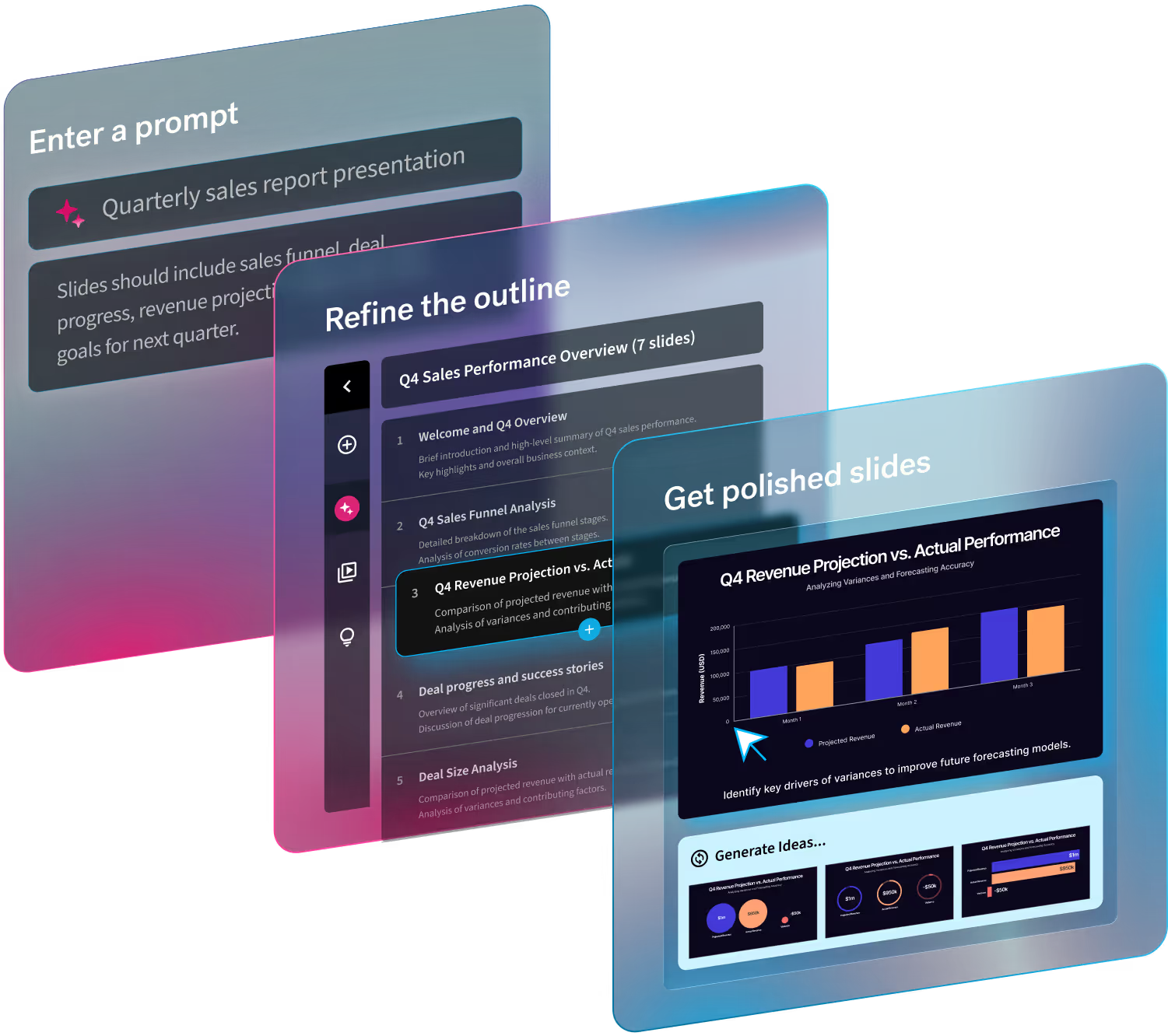
Beautiful.ai is purpose-built around one idea: artificial intelligence should handle the design so you can focus on the story. Every slide uses Smart Slide technology — an auto-layout engine that adjusts spacing, alignment, typography, and visual hierarchy as you add content. You never drag a text box or manually resize an image. The result is consistently polished, professional presentations without any design skill.
Beautiful.ai's AI presentation maker generates complete slide decks from a text prompt, and the output is notably better than most competitors because every generated slide inherits the same Smart Slide design guardrails. Brand kit management keeps your fonts, colors, and logo consistent across every presentation your team creates. The PowerPoint add-in means you can export clean .pptx files that hold their formatting — a critical advantage when deliverables need to travel outside your organization.
Where Beautiful.ai stands out is removing the gap between "first draft" and "final presentation." Other tools generate a rough AI draft that needs heavy manual cleanup. Beautiful.ai's auto-formatting means the first draft already looks finished. Professionally designed presentation templates cover pitch decks, business reports, marketing plans, sales decks, and more, while Smart Slide templates give you modular building blocks for any layout.
- Price: Pro $14.50/month, Team $40/month, Enterprise custom.
- Best for: Teams and professionals who want a polished PowerPoint alternative with AI-powered presentation design and zero manual formatting. Note: Beautiful.ai is cloud-based with no offline access, but its export-to-PowerPoint quality means you can work offline in .pptx after exporting.
Microsoft PowerPoint — bnest for business & enterprise professionals
Microsoft PowerPoint remains the global standard for business presentations. Every Fortune 500 company, consulting firm, and investment bank runs on it. The reason is simple: unmatched formatting control, universal .pptx compatibility, offline editing, and the deepest feature set of any presentation tool. Microsoft Copilot adds AI capabilities for drafting slides, summarizing content, and suggesting layouts, though it requires a separate Copilot subscription.
PowerPoint's weakness is that it demands skill to produce attractive slides. Default templates look dated, and without design discipline, presentations quickly become cluttered. Real-time collaboration works but is less fluid than Google Slides. Still, if your work involves client deliverables, board presentations, or anything shared as a .pptx file, PowerPoint is the default for a reason.
- Price: Microsoft 365 Personal $6.99/month, Business $12.50/user/month, standalone $179.99.
- Best for: Business professionals, consultants, finance teams, anyone delivering .pptx files.
Google Slides — best free presentation software for team collaboration
Google Slides offers the best real-time collaboration of any presentation app. Multiple editors can work simultaneously with zero friction — no software installation, no file conflicts, automatic saving and version history. Google's Gemini AI now powers slide generation, text summarization, and image creation directly in the sidebar. For teams already using Google Workspace, Slides integrates seamlessly with Docs, Sheets, and Drive.
The trade-off is design depth. Google Slides offers fewer templates, limited chart types, and less formatting precision than PowerPoint. PowerPoint import and export can break complex formatting. For collaborative workflows where speed and access matter more than pixel-perfect design, Google Slides is the clear winner, and it is completely free for personal use. Small businesses tend to outgrow it at the same point: the first proposal or pitch deck a customer will judge. That is when teams add a design-focused tool like Beautiful.ai or Canva alongside Slides, or switch outright.
- Price: Free for personal use, $12/user/month with Google Workspace.
- Best for: Remote teams, educators, budget-conscious users, Google Workspace organizations.
Apple Keynote — best presentation ppp for Mac & design-first presenters
Keynote produces the most visually polished presentations of any traditional tool. Its animations — especially Magic Move transitions — are unmatched. Typography rendering and visual design quality exceed both PowerPoint and Google Slides. For conference speakers and anyone presenting live on a Mac or iPad, Keynote's presenter view and rehearsal tools are excellent.
Keynote's limitation is ecosystem lock-in. It runs only on Apple devices and iCloud web. PowerPoint export loses formatting and animations. Business adoption is limited because most organizations standardize on .pptx. Keynote is a superb tool inside Apple's walled garden but impractical for cross-platform enterprise environments.
- Price: Free on all Apple devices.
- Best for: Apple ecosystem users, conference speakers, design-conscious presenters.
Canva — best presentation maker for marketing & quick designs
Canva brings an enormous ecosystem of templates, stock photos, icons, and design assets to presentation creation. Magic Design AI generates presentations from prompts, and the drag-and-drop interface makes it accessible to anyone without design training. Brand kit management (on paid plans) helps marketing teams maintain visual consistency across decks, social media graphics, and print materials.
Canva's output tends to read as "marketing deck" rather than "enterprise presentation." If you need to export to PowerPoint, Canva layouts often break during conversion. Data visualization capabilities are limited compared to PowerPoint or dedicated tools. But for marketing teams, small businesses, and non-designers who need drag-and-drop presentation creation that delivers visually appealing slides fast, Canva is hard to beat.
- Price: Free (generous tier), Pro $12.99/month, Teams $10/user/month.
- Best for: Marketing teams, small businesses, non-designers needing polished output quickly.
Gamma — best AI presentation maker for web-native decks
Gamma takes a fundamentally different approach: card-based, responsive presentations that look more like interactive web pages than traditional slide decks. Describe what you want, and Gamma's AI generates a polished deck in under 60 seconds. The output supports live embeds — YouTube videos, Figma files, interactive charts — making it ideal for asynchronous sharing where recipients view the presentation on their own time.
Gamma's card-based format is not suitable for every context. PowerPoint export requires formatting cleanup. There are no consulting-grade chart types or advanced data visualization tools. But for startups, marketers, and anyone sharing presentations via link rather than projector, Gamma is the fastest path from idea to polished output.
- Price: Free (400 credits), Plus $8/month, Pro $15/month.
- Best for: Startups, web-native presentations, asynchronous sharing, fast AI-generated drafts.
Prezi — best for non-linear, interactive presentations
Prezi replaces traditional linear slides with a zoomable canvas. Instead of clicking through a sequential slide deck, you navigate a visual map — zooming into topics and panning between ideas. This non-linear approach genuinely engages audiences differently, particularly in educational and creative contexts. Prezi Video overlays your presentation content directly on your webcam feed during video calls, which is uniquely useful for remote presentations.
The trade-off is compatibility. Prezi exports to PDF only — no .pptx option — making it an impractical PowerPoint alternative for business environments that require editable slide files. The canvas format has a steeper learning curve, and the novelty can distract from content in formal settings. But for educators, creative presenters, and conference speakers who want to stand out, Prezi offers something no other tool does.
- Price: Free (500 AI credits), Plus $19/month, Premium $29/month.
- Best for: Educators, creative presenters, conference speakers, remote video presentations.
Pitch — best presentation tool for sales teams & analytics
Pitch combines presentation creation with engagement analytics. Share a deck through Pitch's platform and you can see who viewed it, how long they spent on each slide, and where they dropped off. For sales teams that send pitch decks digitally and need data on prospect engagement, this is a genuine competitive advantage. Real-time collaboration is strong, brand management features enforce visual consistency, and templates are professionally designed.
Pitch's analytics only work when sharing through its own platform. Team pricing escalates quickly ($80/month for business plans). PowerPoint export loses interactive features. Pitch is excellent for sales-focused teams tracking presentation engagement but too specialized for general-purpose use.
- Price: Free, Pro $8/user/month, Business $80/month (teams).
- Best for: Sales teams, agencies tracking presentation engagement, collaborative pitch creation.
Slidebean — best presentation software for startup pitch decks
Slidebean is narrowly focused on startup fundraising. It includes AI-formatted slide layouts, investor-specific templates modeled after successful funded startups, financial model builders, and optional professional consulting services for pitch strategy. If you are a startup founder building a pitch deck, Slidebean's focused toolset adds genuine value.
For anyone outside the startup fundraising workflow, Slidebean is too specialized. It does not work inside PowerPoint, offers limited data visualization, and is not suitable for general business or marketing presentations.
- Price: Free (limited), Premium $10–19/month, Professional $29/month.
- Best for: Startup founders raising capital, investor pitch decks.
How AI Is changing presentation software in 2026
Text-to-presentation and generative AI slides
The most visible AI feature across presentation tools is text-to-presentation: describe your topic, audience, and tone, and the AI generates a complete slide deck. Beautiful.ai, Gamma, Canva, and Prezi all offer this capability, but output quality varies significantly. The key differentiator is not whether a tool can generate slides from a prompt — they all can — but whether the generated output is actually usable without heavy manual editing. Beautiful.ai's AI presentation maker consistently produces the most presentation-ready first drafts because its Smart Slide engine enforces professional design rules on every generated slide.
Auto-layout engines and smart design guardrails
Beyond content generation, AI increasingly handles layout intelligence. Beautiful.ai pioneered this with Smart Slides: add an image, chart, or text block, and the layout automatically adjusts to maintain visual balance, consistent spacing, and typographic hierarchy. This is fundamentally different from tools where AI generates a first draft but leaves you to manually fix alignment, spacing, and font sizes. Design guardrails mean even non-designers produce professional output — a critical advantage for teams without dedicated slide designers.
AI image generation and brand consistency
Several tools now include AI image generation directly in the editor. Canva, Visme, and Google Slides (via Gemini) can create custom visuals from text prompts. Beautiful.ai's brand kit management takes this further by ensuring every AI-generated element — layouts, color palettes, font families — adheres to your organization's brand guidelines. For enterprise teams managing brand consistency across dozens of presenters, this automated brand enforcement is more valuable than any single AI feature.
How to get the most from your presentation software
Regardless of which tool you choose, a few practices maximize your results. Start with your brand kit: upload your logo, define your color palette and font families, and set these as defaults before creating any presentation. Use master slides or custom templates to enforce consistency across your team. Take advantage of presenter view and speaker notes during live delivery — they are available in PowerPoint, Google Slides, Keynote, and Beautiful.ai. If you share presentations asynchronously, use tools with engagement analytics (Pitch, Gamma, or Beautiful.ai) to understand which slides resonate and where viewers drop off. And always test your export: if the final file needs to be .pptx, verify that formatting survives the conversion before sending it to a client.
For teams working across multiple presentation formats — pitch decks, quarterly reviews, training materials, and marketing decks — a platform like Beautiful.ai that enforces brand consistency and auto-formats every slide type is more efficient than manually maintaining templates in a traditional tool.
Final verdict: the best presentation software for 2026
The best presentation software is the one that fits your workflow without creating extra steps.
- For AI-powered presentations that look professional without manual design work, Beautiful.ai is the clear leader. Its Smart Slide engine, brand kit management, and clean .pptx export make it the best choice for teams that want polished output with minimal effort. Start with a free trial to see the difference.
- For enterprise and consulting work, PowerPoint remains the industry standard — enhanced by Copilot AI and a deep add-in ecosystem.
- For team collaboration on a budget, Google Slides is unbeatable. Free, browser-based, and seamlessly integrated with Google Workspace.
- For marketing and quick designs, Canva's template library and drag-and-drop tools deliver the broadest creative flexibility.
- For startups building pitch decks, both Beautiful.ai's dedicated pitch deck templates and Slidebean's fundraising-focused platform serve founders well.





.avif)
